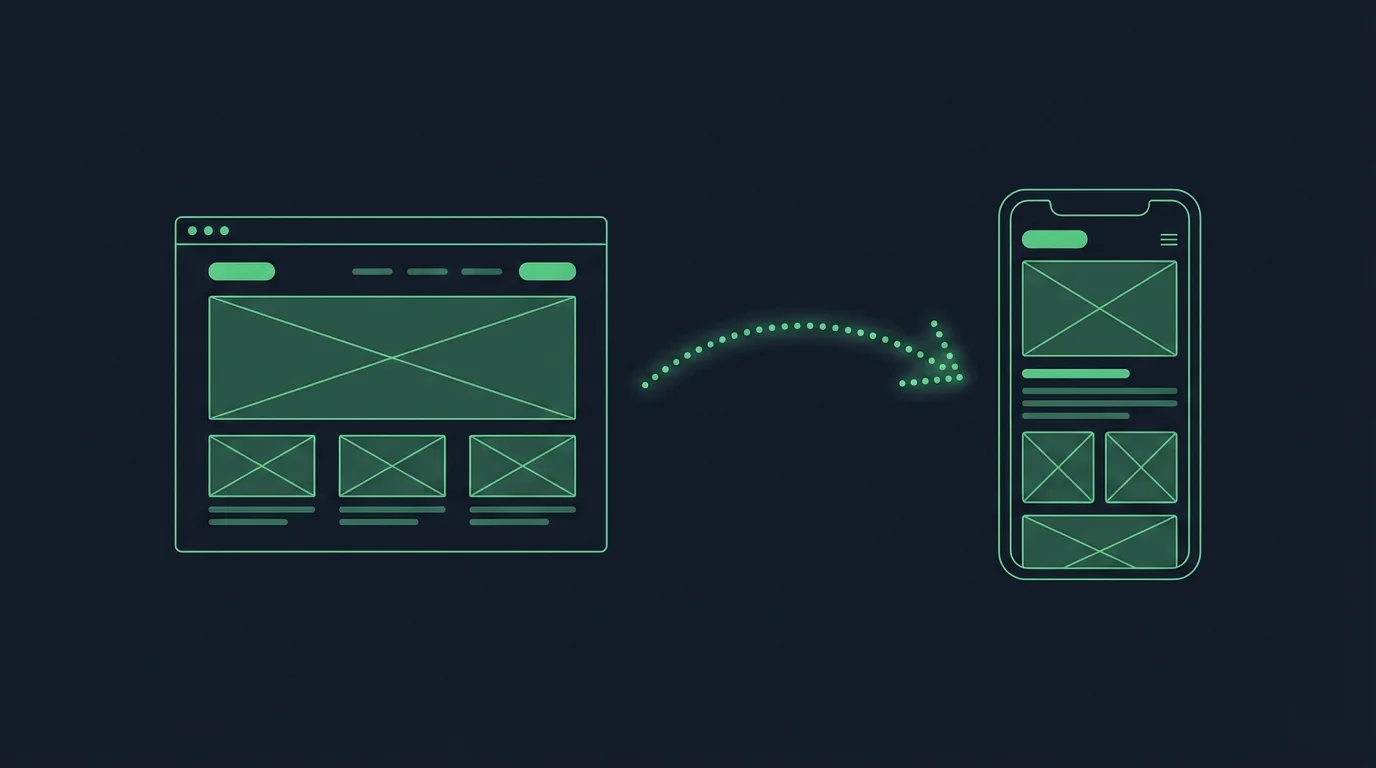
Your mobile website has the hardest job in your business. It has to work for everyone who arrives from search, ads, social posts and shared links, from someone who heard your name 30 seconds ago to a customer who’s bought from you twenty times.
And while it does a decent job of serving a range of different visitor types, it’s not ideal for your repeat users, those who know what they want and want a frictionless way to get there.
That’s why more and more online brands today have their own mobile app. Those who do see a different kind of customer coming through each channel, with very different results.
This guide compares mobile apps and mobile websites side by side, with current data on time spent, conversion rates, order values and push notifications, results from MobiLoud’s own ecommerce benchmark report and a simple way to decide what your business needs.
How Do Mobile Apps and Mobile Websites Compare?
A mobile app and a mobile website can sell the same products and publish the same stories, but they reach people in different ways and do different jobs for your business.
| Mobile website | Mobile app | |
|---|---|---|
| How you get there | Tap a link or a search result, with nothing to install | Download it from the App Store or Google Play |
| Who it’s for | Everyone, from first-time visitors to regulars | Mostly repeat customers and loyal readers |
| How people find it | Search engines, ads, social posts and shared links | App store search, your website, emails, packaging and stores |
| On mobile | A browser tab or a bookmark | An icon on the home screen |
| Signing in | Signed in until the session expires or cookies are cleared | Customers stay signed in, with their details saved |
| Push notifications | Web push, which on iPhone needs the site added to the Home Screen first | Native push to everyone who opts in |
| Device features | Limited, especially on iPhone | Face ID, camera, location and more |
| Conversion rate | Lower, because it serves every visitor | 1.7 to 3 times higher than mobile web (MobiLoud benchmark report) |
| What to measure | Reach, search traffic, first orders and conversion rate | Active users, repeat purchases, revenue per user and push opt-in |
| Best suited to | Discovery and first purchases | Retention, repeat orders and daily habits |
Your website wins on reach. Your app wins on almost everything that happens once someone already knows you.
A mobile website isn’t the same thing as a web app, which is interactive software like Google Docs that runs in the browser. If that’s the choice you’re weighing, our guide to mobile apps vs web apps covers what you need to know.
Mobile App vs Mobile Website Statistics
These figures sum up how mobile apps and mobile websites compare on time spent, conversion, revenue and push. We’ll break down each one again in more detail below.
- 3.6 hours Time the average mobile user spent in apps each day in 2025 Sensor Tower, January 2026
- 90% Share of US adults' smartphone time spent in apps rather than browsers, in eMarketer's 2020 estimate eMarketer, July 2020
- 1.7x to 3x Higher conversion rates in apps than on mobile web, across the brands in our benchmark report MobiLoud, 2025
- 37% More spending by a retailer's app adopters than by customers who didn't adopt the app, after it launched Marketing Science, 2019
- 24% to 65% Share of mobile revenue earned by apps used by 2% to 16% of three brands' mobile users MobiLoud, Q1 2025
- 63.93% Push opt-in rate on iPhone for the top 10% of retail apps (69.85% on Android) Airship, 2025 data
Do People Spend More Time in Apps Than in Mobile Browsers?
People spend far more of their phone time in apps than in mobile browsers. The last widely published split, an eMarketer estimate from 2020, put apps at 90% of US adults’ smartphone time.
App time has kept growing since then. People spent 5.3 trillion hours in iOS and Google Play apps in 2025, up 3.8% on the year, or about 3.6 hours a day per mobile user, according to Sensor Tower’s State of Mobile 2026.
Much of that time goes to the apps people open every day, like messaging, social media and video. A brand’s app doesn’t win a share of it just by existing.
What the numbers show is a habit. When people do something regularly on their phone, whether that’s checking the news, reordering skincare or browsing a favorite store, they tend to do it in an app.
That’s the habit a brand’s app taps into. It gives the customers and readers who already come back every week the format people prefer for the things they do often.
What Your Mobile Website Does Best
Your mobile website is the version of your brand that anyone can reach, with nothing to download and no commitment. That makes it your main tool for discovery and first purchases.
Search engines index its pages, so people find your products and articles on Google and in AI answers. Ads, social posts, emails and links shared in group chats all open straight to the right page.
Someone who taps your Instagram ad isn’t going to download an app to see one product. They need a fast page that shows what you sell and lets them buy without friction.
That broad audience is also why mobile website numbers look weaker next to an app’s. Your site serves first-time visitors, comparison shoppers, readers passing through from a search and people who leave within seconds. Many of them were never close to buying.
So a lower conversion rate on mobile web doesn’t mean your site is failing. It’s doing a harder job for a much wider audience, and making it faster pays off for every visitor. A progressive web app is one way to do that in the browser.
What Does a Mobile App Add? (That a Website Doesn’t)
A mobile app gives the customers who already know you a faster, more direct way to come back. It also gives you a way to reach them without waiting for them to search for you or open an email.
The best brand apps aren’t copies of the mobile site. They’re built for the people who come back, with things a browser can’t offer:
- A place on the home screen. Your icon sits next to the apps people open every day, one tap away, instead of buried in a list of browser tabs.
- Customers who stay signed in. Accounts, saved addresses, wishlists and payment details are there every time, so a repeat order takes seconds.
- Push notifications. You can reach people on their lock screen with a new drop, a restock, breaking news or a reminder about their cart, with no cost per message.
- Experiences built for the phone. Native navigation, app-only pages, early access and loyalty perks give people a reason to open your app rather than the browser.
- Device features. Face ID sign-in, barcode scanning, location and the camera let you build features a browser can’t match.
That’s what turns an app into a channel of its own. Cold Culture, a Spanish streetwear brand that releases new collections every week, gave its app a custom layout designed for impulse buying, and now uses push notifications rather than email as the main way to announce its drops.
Do Apps Convert Better Than Mobile Websites?
The data shows that, yes, apps convert better than mobile websites. Across the live ecommerce apps in MobiLoud’s Ecommerce Mobile App Benchmark Report, apps delivered 1.7 to 3 times higher conversion rates than mobile web, with average order values 10% to 50% higher.
Revenue per user moves even further. App users brought in 3.5 to 7 times more revenue per user than mobile web visitors, and their lifetime value was 2.8 to 5 times that of web-only shoppers.
Is It the App or the Audience?
Part of the conversion gap between apps and mobile websites comes from who uses the app. People who download a brand’s app already know it and plan to come back, while the mobile website also serves every first-time visitor from an ad or a search.
But the app changes how people shop, too. A 2019 study in Marketing Science tracked a large retailer’s customers before and after it launched an app, comparing those who adopted it with those who didn’t.
After the launch, app adopters bought 33% more often and spent 37% more than non-adopters. They also returned more, but they still spent 36% more after returns. Their purchases rose in the retailer’s stores as well as online.
So the gap isn’t just loyal customers choosing the app. Having the app makes them shop more often.
How Much Revenue Can a Small App Audience Drive?
A small app audience can bring in a large share of revenue, because app users buy more often and spend more when they do. You don’t need every visitor to download your app for it to matter.
MobiLoud’s Ecommerce Mobile App Benchmark Report shows how far that goes. Here are the real splits from three brands we tracked over one quarter, comparing app vs web.
| Brand | Conversion rate (app vs mobile web) | Average order value (app vs mobile web) | Share of mobile users on the app | Share of mobile revenue from the app |
|---|---|---|---|---|
| Brand A (wellness) | 9.06% vs 1.14% | $97.85 vs $63.83 | 16% | 65% |
| Brand B (luxury fashion) | 2.56% vs 0.23% | $103.57 vs $59.17 | 2% | 35% |
| Brand C (cosmetics) | 2.79% vs 1.49% | $54.78 vs $44.29 | 9% | 24% |
Brand B shows the pattern most clearly. Only 2% of their mobile users were on the app, but they brought in 35% of its mobile revenue.
The size of the gap varies by brand, from about twice the mobile web conversion rate for Brand C to 11 times for Brand B. The direction doesn’t change, though. Every brand converted better in its app.
The same pattern shows up at Tadashi Shoji, the luxury fashion label. Its app now brings in 18% of total online revenue and 30% of mobile revenue, and app users convert at 8.3 times the rate of mobile web visitors.
Can a Mobile Website Send Push Notifications?
A mobile website can send push notifications, but far fewer people end up receiving them than with an app. On Android, visitors can allow web push straight from the browser.
On iPhone and iPad, a website can only send push once someone adds it to their Home Screen, on iOS 16.4 or later, and then taps to allow it, according to WebKit. Few people take those steps.
An app doesn’t need those extra steps. It can ask for permission when someone opens it, and the top 10% of retail apps get 63.93% of iPhone users and 69.85% of Android users to opt in, according to Airship’s benchmarks for 2025. The median retail app gets 43.5% on iPhone and 49.95% on Android.
That’s the real difference between web push and app push. A website can only ask the visitors who take those extra steps, while an app can ask everyone who downloads it.
People act on those notifications. Ecommerce push had click-through rates of 3.05% on iOS and 3.78% on Android from late 2024 to mid-2025, according to Pushwoosh.
The revenue adds up fast. In MobiLoud’s benchmark data, one brand recovered $360,496 from abandoned cart notifications in March 2025 alone, and a wellness brand earned more than $31,000 from push in April 2025, shortly after turning it on.
Push works for publishers as much as stores. Lakers Nation, a sports news site from Medium Large Sports Media, sends updates through the day in its app, and app readers come back about six times a month for around 10 minutes a visit.
Mobile App, Mobile Website or Both: Which Fits Your Business?
Every business that sells or publishes online needs a strong mobile website. Whether you also need an app depends on how often your customers come back.
| Your business | Role of mobile web | Role of the app | Best fit |
|---|---|---|---|
| Online store with repeat customers (fashion, beauty, wellness, groceries) | Brings in new shoppers from search, ads and social | Reorders in a few taps, restock alerts, loyalty and saved details | Both, with the app for your regulars |
| Brand built on drops and launches | Reaches people who hear about a drop | An alert the moment a drop goes live | An app is ideal |
| Publisher or content brand with daily readers | Wins traffic from search and social | Breaking news alerts and a daily reading habit | Both |
| Membership, subscription or community | Sign-ups and account management | A members’ space on the home screen, with reminders | An app is a strong fit |
| Big-ticket or one-off purchases | Research, comparison and checkout | Little reason for customers to keep it | Mobile website first |
| New brand still finding its customers | Awareness and first orders | Too few repeat customers to use it yet | Mobile website first, app later |
For most established brands, the answer is both. The website keeps bringing new people in, and the app gives the ones who come back a better place to shop or read.
”In our experience, users break into two camps. There are users who prefer to buy on the app and users who prefer using the browser. You can’t convince one to go the other way, you need to meet them where they are.”
When a Mobile Website Is Enough
A mobile website on its own is enough when an app wouldn’t have an audience to serve yet. That’s usually the case when:
- Most customers buy once, or only every few years
- Phones bring in a small share of your sales
- You don’t yet have a base of repeat customers or regular readers
- Your mobile site still struggles with speed or checkout, which an app won’t fix for everyone else
Signs You’re Ready for an App
An app is best suited to brands with customers who already come back on their own. These are the clearest signs:
- A meaningful group of customers who buy again, or readers who visit every week
- Products or content that give people a reason to return, like replenishment, new collections, drops or daily news
- Moments worth a push notification, such as launches, restocks, price drops, breaking news and abandoned carts
- A loyalty program, subscriptions or member perks that would work better in an app
- Places to promote the app, from your website and emails to packaging, stores and social
Getting a Native App Without Building a Second Product
The biggest downside of a native app has always been what it takes to build and run one. A custom app is a second product, with its own code for iPhone and Android, its own roadmap and a team to keep every product, page and integration in step with your website.
That’s the part MobiLoud takes away. MobiLoud transforms your website into a custom native app, powered by the same underlying code as your website.
We build your app from your website’s code, so it launches with a head start: your products, menus and content, plus features like search, loyalty and subscriptions, from day one. Then we design a fully custom, native interface around them, made for the phone rather than the browser.
On top of that come the experiences only an app can offer. That means push notifications, app-only pages your team builds in your own platform, native features and integrations with the SDKs and device features your business needs.
Your app can look and feel very different from your website, but because both feed from the same codebase, the two always stay consistent. Our team builds, launches and looks after your app, so there’s nothing for your team to maintain.
We’ve helped brands like John Varvatos, Jack & Jones and Tadashi Shoji launch their apps this way, and most brands go live in the App Store and Google Play in 2 to 4 weeks.
Mobile App or Mobile Website? (Final Thoughts)
A mobile app and a mobile website aren’t rivals. Your website is how people find you, and it has to work for everyone. Your app is how the people who already love what you do stay close.
The data points the same way across every source in this guide. Apps convert better, and app users buy more often and spend more. Push gives you a direct line to them at no cost per message.
None of that depends on getting every visitor to download your app. A small share of loyal customers can carry a large share of your mobile revenue, as long as they have a home on their phone to come back to.
So if a real part of your business comes from people who return, the question isn’t whether an app can beat your website. It’s how much more those customers would buy and read if you gave them an app built for them.